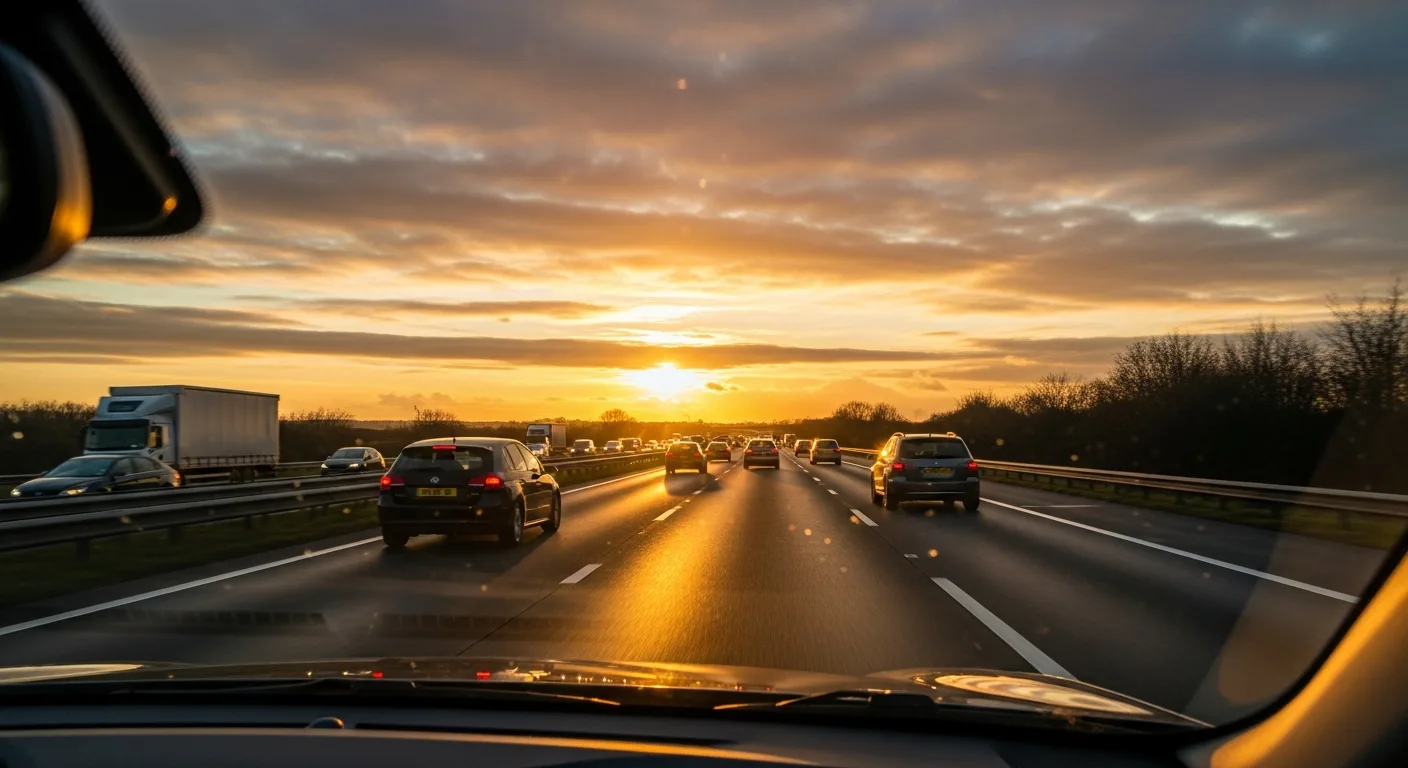
Every dash cam maker leads with resolution, and "4K" has become shorthand for "the good one". But resolution is only worth paying for if it changes the outcome on the day you actually need the footage. So let's answer the question properly: what does each tier really give you, and when does 4K earn its price?
What the numbers mean
- 1080p (Full HD) — 1920×1080, about 2 million pixels per frame. The baseline for years.
- 1440p (2K/QHD) — 2560×1440, about 3.7 million pixels. Roughly 78% more detail than 1080p.
- 4K (UHD) — 3840×2160, about 8.3 million pixels. Four times the detail of 1080p.
That last line is the one to hold onto. A registration plate that occupies 60 pixels of width in a 1080p frame occupies around 120 pixels in 4K — the difference between guessing at characters and reading them at a glance.
The plate-reading test
Think about when a plate needs to be readable in your footage: the car that cut across you is already two lanes away; the van that clipped a wing mirror is accelerating off; the driver who caused a near-miss never stopped at all. In each case the vehicle is distant, moving, or both — and that's precisely where pixel count decides everything.
Close up and stationary, any modern camera reads a plate. At 20 metres, at an angle, in traffic? 1080p frequently produces characters you almost recognise — which is to say, characters an insurer or police officer can't act on. 4K keeps meaningful detail at distances where lower resolutions have already given up.
Where 4K genuinely changes outcomes
- Motorway and dual-carriageway driving. High closing speeds mean the critical vehicle is often far away by the time the moment has passed. More pixels preserve the evidence.
- Zooming after the fact. Cropping into a 4K frame still leaves you a sharp, usable image; cropping into 1080p turns detail into mush. Reviewing footage is almost always an exercise in zooming.
- Hit-and-run and near-miss incidents. The cases where you get exactly one chance at a plate, a face, or a company name on a van door.
- Wide lenses. A 140° field of view spreads the scene across the sensor. Higher resolution compensates, keeping objects at the frame edges identifiable.
Where the extra pixels don't save you
Honesty matters here: resolution is not a magic ingredient.
- Darkness. Night performance depends more on sensor size and processing than raw pixels — a 4K camera with a poor sensor produces very detailed noise. This is why flagship cameras pair resolution with dedicated low-light modes; our night driving guide digs into it.
- A dirty windscreen or vibrating mount. No pixel count fixes a blurred source. Image stabilisation and basic upkeep protect image quality more than most spec-sheet lines.
- Low bitrate. Resolution tells you the size of the canvas; bitrate decides how faithfully it's painted. Reputable manufacturers pair 4K with an appropriate bitrate — a suspiciously cheap "4K" camera usually hasn't.
Frame rates: the other half of the equation
Most 4K dash cams record at 30fps, which suits general driving. Many — including the Nextbase 622GW — offer 1440p at 60fps for smoother motion rendering, and 1080p at 120fps for super-slow-motion review of a split-second event. Those modes are genuinely useful options rather than gimmicks: fast crossing traffic is easier to analyse at higher frame rates, at the cost of some resolution. For everyday use, 4K/30 is the sensible default; it's the mode that maximises your odds of a readable plate.
The practical costs of 4K
- Storage. 4K files are large. A given card holds fewer minutes of loop, and the constant writing demands a high-endurance card — see our microSD guide before you buy the cheapest card on the shelf.
- Price. True 4K with a good sensor lives in the £150–£300 bracket. Below that, be sceptical of the label.
- Nothing else. Fitting, power draw and day-to-day use are identical to any other camera.
So — worth it?
If your driving is low-speed, local and mostly daytime, a good 1440p camera covers you well, and the money saved is better spent on a high-endurance card and proper fitting. But if you spend real time on fast roads, park where hit-and-runs happen, or simply want the best chance that the one clip that ever matters is legible — yes, 4K is worth it. Resolution is the one spec you cannot add after the incident.
For the full picture of what else matters — field of view, GPS, parking protection — go back to the complete buying guide.